

Porter urges growers to be strategic with irrigation
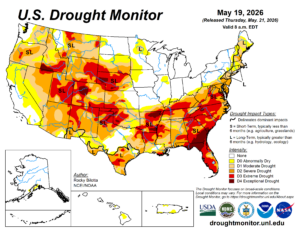
With drought conditions lingering across the Southeast and aquifer levels and surface water sources already running below normal prior to the growing season, irrigation planning is taking on new urgency for peanut growers in 2026.
According to University of Georgia irrigation specialist Wes Porter, the current situation is unlike what many growers are accustomed to entering the 2026 season.
“We’re already below surface and subsurface levels compared to where they were both in 2007 and 2011 at the same time of year, and we haven’t reached peak demand for the season yet,” Porter says. “That’s what worries me. Once we start pumping during peak water requirements, we know what’s going to happen.”
Porter notes monitoring wells across Southwest Georgia that show groundwater levels significantly below average. While some winter recharge typically helps replenish groundwater supplies, this year has brought little relief.
“We’ve had no appreciable recharge because we really haven’t had significant rainfall since September,” he said. “We’re moving into the season already in a drought scenario.”
Despite the concerning outlook, Porter stressed that the message to growers is not panic, it is preparation.
“This doesn’t mean we’re going to run out of water,” he says. “But it does mean we have to have a good plan in place. If we go into this season like a normal year expecting rainfall to refill the profile, and it doesn’t happen, that’s where we get into trouble.”
Irrigation Timing Matters
One of Porter’s biggest concerns is a long-standing misconception about early-season peanut irrigation.
“Somewhere along the way, people were told not to irrigate peanuts during the first 40 days,” Porter says. “I get too many calls every year from growers asking if they’re allowed to irrigate yet.”
His recommendation is straightforward: irrigate as needed early in the season while avoiding overwatering. The UGA Peanut Checkbook method is a good way to document water requirements throughout the entire season. While water requirements are low during the first 40 days after planting, the plants still need soil moisture to ensure that they are supplied with adequate moisture appropriately during the season.
“We know over-irrigating peanuts can reduce yield,” he explains. “But we also know getting too dry reduces yield, too. There’s a fine line in the middle where we need to hit the target.”
Porter emphasized that maintaining adequate soil moisture late in the season may be just as important. Research conducted over the past several years has consistently shown yield reductions when irrigation is reduced too aggressively during the final 30 to 40 days before harvest.
“We’ve seen four- to five-hundred-pound yield losses when growers back off irrigation too much at the end of the season,” he says. “That’s a significant economic hit.”
At current peanut prices, Porter estimates those losses can equal roughly $80 per acre, while the irrigation required to protect that yield may only cost a fraction of that amount.
“You might spend $20 in irrigation to protect $60 to $80 worth of yield,” he says. “The return is there.”
Technology Can Help – But It Still Requires Judgment
Porter encourages growers to use available irrigation management tools, including soil moisture sensors and irrigation scheduling programs. Any of these irrigation scheduling aids will help farmers better manage their irrigation and target the water requirements so that water is not wasted.
Overall, he said Irrigator Pro continues to perform well, especially when paired with field sensors.
“When coupled with a sensor, Irrigator Pro does a very good job,” Porter says. “But really, using a sensor in general does a good job. There are a lot of good options on the market.”
He also mentions tools like the SmartIrrigation CropFit App, while cautioning growers against relying entirely on automated recommendations without field verification.
“You still have to take your own observations into account,” Porter says. “If you blindly follow a crop model without looking at what’s happening in the field, you can miss problems and not realize it until it’s too late.”
One example involved a center pivot system with incorrect sprinkler orifices that created uneven water application across a peanut field. This issue became obvious after aerial imagery revealed stressed bands running throughout the field.
“In a year like this, any irrigation problem is going to show up immediately,” Porter says. “A non-uniform pivot is going to cost you yield.”
Staying Ahead of Compliance Issues
Porter also encouraged growers to stay current with irrigation permits and water-use compliance requirements, particularly in Southwest Georgia with the new permit options.
He noted that the Georgia Environmental Protection Division is actively working with growers to resolve compliance issues and help operations remain in good standing.
“The important thing is to stay on top of it,” Porter says. “There are people willing to help growers get back into compliance.”
Preparing for an Uncertain Season
While weather conditions could still improve, Porter believes growers should plan conservatively until significant rainfall materializes.
“We need to go into this year assuming we are not going to get refilled,” he says. “And if we do get refilled, then great. But we can’t count on it.”
For peanut growers facing another potentially dry season, Porter said the key will be proactive management, careful irrigation scheduling and making full use of the tools already available.
“This is one of those years where attention to detail matters,” he says. “Monitoring, scheduling and staying ahead of issues will make a difference.”
By Joy Crosby