
 On July 4, 2025, H.R. 1, the One Big Beautiful Bill Act (OBBBA), was signed into law following votes of approval by the U.S. Senate and U.S. House of Representatives. The primary purpose of a budget reconciliation bill is to fast-track legislation required for federal spending, revenue, and the debt limit.
This “mega bill” included key provisions historically part of the traditional Farm Bill process. The most recent Farm Bill—the Agricultural Improvement Act of 2018—originally expired in 2023, but was on its second temporary extension, set to expire in September 2025. The U.S. House Agriculture Committee and U.S. Senate Agriculture Committee both prioritized many typical Farm Bill provisions to be strategically included in the budget reconciliation package, additions which focused on investments in rural America. However, since these items moved forward through the budget reconciliation process, Congress could only include provisions with a direct impact on federal spending or revenue. Lawmakers plan to address the remaining Farm Bill provisions by introducing a smaller legislative version of the Farm Bill at a later date.
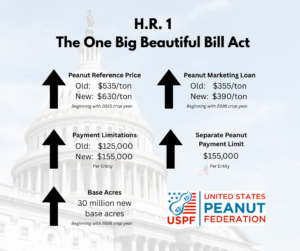
The final OBBBA legislation included the top policy priorities for the U.S. Peanut Federation; an increase in the reference price for the Price Loss Coverage (PLC) program, a voluntary base acres update, a marketing loan increase, and modified payment limitations that reflect increased costs of production, all of which are now set as law through 2031.
Reference Price Increase: The legislation raises statutory reference prices for major commodities through the 2031 crop year. Language is included to address the 2031 crop year and beyond, when reference prices will increase by 0.5% each year on a compounded basis, although the total growth cannot exceed 113% of the initial value. This approach allows prices to track long-term market trends while preventing excessive escalation. Peanut growers will experience an increase in reference price from $535/ton to $630/ton, beginning with the 2025 crop year.
Voluntary Base Acres Update: For the first time in more than ten years, USDA will allow farms without existing base acres or with minimal base acres—but with a history of producing eligible crops—to receive up to 30 million newly designated base acres. Farmers can participate without giving up any current base acres. To qualify, farms must have planted or attempted to plant eligible crops during 2019–2023. Allocations will be distributed in proportion based on the average of 2019-2023 plantings and prevented plantings. Beginning in 2026, producers may qualify for PLC or ARC payments with the new base acres. This opportunity is voluntary, and a landowner may opt out of receiving additional base acres if they wish.
Peanut Marketing Loan Increase: For crop years 2026–2031, the marketing loan rate for peanuts will be set at $390 per ton. The new marketing loan rate is an increase from the current loan rate of $355 per ton, which has been set since the 2002 Farm Bill when the new peanut program was established. Storage and handling provisions are also included.
Payment Limit Increase: The payment limit is now $155,000 per entity, which is an increase from the previous limit set at $125,000 per entity. There is also a separate $155,000 limit set specifically for peanuts. Starting with the 2025 crop year, the $155,000 payment limit will be annually adjusted based on inflation using the Consumer Price Index (CPI) for All Urban Consumers.
###
The United States Peanut Federation (USPF) is comprised of the Southern Peanut Farmers Federation, the American Peanut Shellers Association, and the National Peanut Buying Points Association. USPF serves as a unified voice in Washington D.C. for all sectors of the peanut industry and advocates actively for strong agricultural policy. For additional information, contact Lorene Parker at (202) 543-7464 or by emailing lparker@reddingfirm.com.