

New artificial intelligence technology aims to improve speed,
consistency and accuracy at peanut buying points.
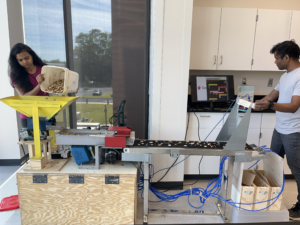
Priyanka Kumari and Pandian Rajaram demonstrate a prototype of the Wiregrass AI Peanut Sorter. The sorter, developed by See Produce, is designed to help streamline the sorting process by using artificial intelligence and machine vision technology to identify and separate peanut samples quickly and consistently.
As peanut harvest season approaches across the Southeast, a new technology developed in the Wiregrass region is preparing to make its debut in one of the most labor-intensive parts of the peanut industry: sorting farmer stock peanuts.
The Wiregrass AI Peanut Sorter, developed by See Produce, is designed to help streamline the sorting process by using artificial intelligence and machine vision technology to identify and separate peanut samples quickly and consistently. While peanut grading remains a regulated process that follows established industry standards, this new system seeks to improve one of the critical steps that occurs before grading, helping buying points increase efficiency, consistency and accuracy during the busy harvest season.
What began as a mission to reduce food waste has evolved into one of Alabama’s most promising agricultural technology startups. Founded by Pandian Rajaram and Priyanka Kumari, See Produce combines artificial intelligence with practical agricultural applications, developing tools that can evaluate produce quality, predict shelf life and now assist with peanut sorting. The company’s latest innovation, the Wiregrass AI Peanut Sorter, reflects its broader goal of using technology to create greater efficiency and consistency throughout the agricultural supply chain.
The upcoming harvest season will mark a major milestone for the project as the technology moves from development and testing into real-world use.
“The upcoming harvest season is a very important milestone for the Wiregrass AI Peanut Sorter and Grader. For the first time, we’re putting industry-grade machines into the field to sort real farmer stock peanuts at buying points. Our goal this season is to test, evaluate and improve. Then bring it to all ~1,100 grading and regrading stations, so every buying point can grade faster, more accurately and more consistently, with shorter lines, and every farmer gets fair pay for every load,” Kumari says.
Unlike traditional sorting methods, which require two to four workers sorting by hand for 10 to 12 hours a day across roughly 100 consecutive days each season with no breaks or holidays, the Wiregrass AI Peanut Sorter tackles what has long been one of the most physically demanding jobs at buying points. That sustained workload leads to fatigue, and fatigue directly impacts sorting accuracy, consistency and speed as the season progresses.
Using advanced cameras and artificial intelligence, the system identifies and separates farmer stock peanuts into three primary categories: pods, loose shelled kernels (including kernels and split kernels) and foreign materials such as sticks, stones, empty shells, raisins and dirt. By automating this critical process, the system provides a level of consistency that is difficult to maintain through manual sorting alone. The goal is to bring greater speed, accuracy and repeatability to this essential step, helping ensure every load is handled with the same precision on day one as on day one hundred.
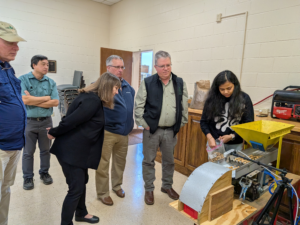
Priyanka Kumari demonstrates how the Wiregrass AI Peanut Sorter operates using a prototype during a demonstration at the Georgia Federal-State Inspection Service.
The technology’s potential benefits extend throughout the peanut supply chain. For growers, improved sorting consistency can help increase confidence that every load is being handled fairly and uniformly. For buying points and warehouses, the system could help improve workflow efficiency during one of the busiest times of the year while reducing the physical demands associated with manual sorting.
“By training our models on thousands of data points from farmer stock peanut samples right here in the Wiregrass, we’ve built our See Produce AI that truly understands the crop,” Rajaram says. “It can detect everything from pods, kernels and split kernels to foreign materials, including hard-to-catch ‘raisins,’ at around 95 percent accuracy. That brings an unprecedented level of precision to peanut sorting, and it automatically sorts the farmer stock into three specific bins for pods, loose shelled kernels, and foreign material faster than any traditional method. The best part is, as we keep optimizing, it only gets more accurate and sorts even faster with every load.”
Development of the sorter has been driven by a vision to modernize peanut handling while maintaining the integrity and standards that producers depend on. Rather than replacing existing expertise, the goal is to provide an additional tool that supports the industry through advanced imaging, artificial intelligence and consistent data-driven decision-making.
As harvest begins, researchers and developers will gather valuable information from real-world conditions to continue refining the technology. The data collected this season will help identify future improvements and guide broader implementation opportunities across the peanut industry.
If successful, the Wiregrass AI Peanut Sorter could represent a significant step forward in how farmer stock peanuts are processed, creating a system that is faster, more consistent, and better equipped to serve both growers and buying points.
For an industry that continually balances tradition with innovation, this harvest season may offer a glimpse into the future of peanut handling, one where artificial intelligence helps improve efficiency, consistency, and accuracy while reducing one of the most physically demanding jobs in the industry.
By Peyton Woods