

Using Official Variety Trial data to track peanut maturity
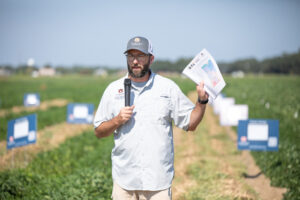
Henry Jordan, research associate with Auburn University, discusses the Official Variety Trial data and how farmers can use the information to evaluate the number of calendar days, total rainfall accumulation and accumulated growing degree days at digging across multiple locations and years for each peanut variety.
At this point in the season, the crop is in the ground. The most important decision of the season was made when peanut varieties were selected. Growers should continue routinely scouting for pests and taking appropriate management actions. Harvest season will arrive soon, and the next major consideration is determining maturity and identifying the optimal time to begin digging. How can variety trial results help determine the optimal digging date? The answer may be surprising.
First, it is important to understand how the peanut Official Variety Trials (OVTs) are harvested. Within each trial, varieties are harvested according to maturity group to avoid biasing the results. For the past several years, varieties have been divided into three maturity groupings: 140, 145 and 150 days. Using days after planting alone to determine maturity is not accurate because temperature and precipitation are the primary drivers of crop development, and no two seasons are alike.
The OVT results can be used to evaluate the number of calendar days, total rainfall accumulation and accumulated growing degree days (GDDs) at digging across multiple locations and years for each variety. Auburn University has partnered with Medius Ag to create an online tool to assist farmers with gathering variety specific data.
Online results show that, using the GDD calculation in the OVT Variety Selection Tool with a GDD threshold of 56 degrees, digging began at approximately 3,400 accumulated GDDs for the earliest-maturing varieties and concluded around 3,600 accumulated GDDs for the latest-maturing varieties. With that information, weather data from the nearest Alabama Agricultural Experiment Station (AAES) can be used to determine where the 2026 crop stands in its development.
There are two methods for accessing this information. The first is through the OVT Variety Selection Tool by selecting the trial location nearest the farm, clicking the weather icon, adjusting the dates and reviewing the summary data. The second option is to visit the AAES Weather Exchange at wx.medius.re, create a free account and access the same information directly.
Once this information is available, growers should not begin digging based solely on a specific GDD value. Instead, the data should be used to determine when to begin pod blasting, which remains the most accurate indicator of peanut maturity. Growers may bring peanut samples to the Wiregrass Research and Extension Center, where Extension personnel typically offer pod blasting services twice each week during harvest season.
The variety selection tool, supported by the Alabama Peanut Producers Association, provides more than yield data alone. Weather information can also be leveraged to support management decisions throughout the growing season. For more information on the Auburn University Official Variety Testing Program and to view results, visit aub.ie/variety-tests.