
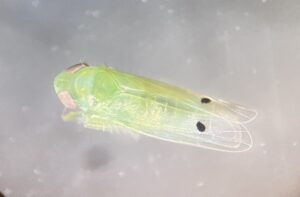
An adult two-spot cotton leafhopper or commonly referred to as an cotton jassid. Photo by Justin Odom, University of Georgia.

A new insect pest spreading across the Southeast has caught the attention of growers and researchers alike. The two-spot cotton leafhopper, commonly referred to as the cotton jassid, is not native to the United States but has quickly become a topic of discussion due to its rapid spread and its impact on cotton.
The pest was first detected in South Florida in 2024. In July 2025, the pest was detected on cotton in the Suwanee Valley area of Florida and quickly spread to Georgia where it was confirmed on okra. From there, populations increased rapidly, and by the end of the 2025 growing season, many cotton acres in Alabama, Florida, Georgia, Mississippi and South Carolina required treatment to control infestations.
Because published host lists from overseas research include crops such as cotton, okra, sunflower, hibiscus, eggplant, and peanuts, the insect has raised concerns among peanut growers. Much of the available information comes from research conducted in India, where the pest is well established and known to be a major cotton pest.
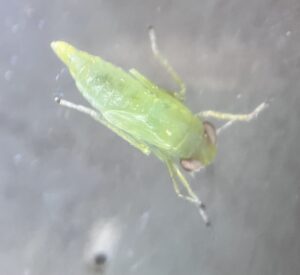
Cotton jassid nymphs are less than 1 mm in length and have oblong light-green bodies. Photo by Justin Odom, University of Georgia.
During the past season, researchers and county agents across the Southeast closely monitored peanut fields for signs of damage. Although two-spot cotton leafhoppers were occasionally found in peanuts, they were typically present only in small numbers. In some cases, large populations temporarily moved into peanut fields after neighboring cotton fields were defoliated late in the season. These migrations generally lasted about a week before the insects moved on.
Despite those temporary increases in numbers, researchers observed no clear signs of feeding injury or yield loss in peanuts. University of Georgia Extension entomologist Mark Abney conducted field studies to determine whether the insects could reproduce on peanut plants. Adult leafhoppers were confined on peanut plants in field cages for two weeks—the time required for eggs to develop into adults. While some insects survived during that period, Abney did not find evidence of egg-laying or developing nymphs.
Isaac Esquivel, University of Florida entomologist, had a peanut trial surrounded by cotton at the North Florida Research and Education Center in Quincy, Florida, and he didn’t observe damage from the cotton jassid either.
“After jassids were detected, they mostly stayed on the cotton until late season once the cotton leaves began to show late-stage hopper burn or defoliation,” Esquivel says. “We did see adult jassids in the peanut field but did not see any reproduction.”
While literature suggests that peanuts are a host for the cotton jassid, those that report damage could also be referring to a different jassid species. While certain leafhoppers can damage peanuts, they are different species than the cotton jassid currently spreading in the Southeast.
For now, Abney remains cautiously optimistic that the pest will not become a significant problem for peanut production. However, growers are encouraged to stay alert.
“If unusual leafhopper populations are observed in peanut fields, growers should contact their county Extension agent before making a treatment decision,” Abney says. “Proper identification and evaluation are important to determine whether management is truly needed.”
While the cotton jassid has already proven to be a serious pest in cotton, current observations suggest it may pose little risk to peanuts. Continued monitoring and communication between growers, agents, and researchers will help ensure any emerging issues are quickly identified and addressed.
By Joy Crosby