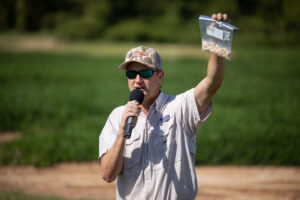
University of Georgia Extension peanut entomologist Mark Abney discusses peanut pod damage from rootworm at a field day. Reducing rootworm injury can significantly improve both yield and grade.

Peanut growers across the Southeast have a new tool to help manage some of the most challenging insect pests in the crop. A new insecticide from Syngenta — marketed under the brand name Vertento — is showing strong potential, particularly for managing peanut rootworms.
The product contains the active ingredient isocycloseram, part of a new mode of action classified in IRAC Group 30, and will be marketed under Plinazolin technology. The insecticide works by both contact and ingestion, causing rapid feeding cessation in target pests.
Vertento is labeled as a foliar insecticide for several crops, including cotton, onions and peanuts. In peanuts, the foliar label targets pests such as thrips and spider mites. But the biggest development for Southeastern peanut producers centers on rootworm management.
Special Label Expands Options for Growers
While the original federal label allows Vertento to be applied through chemigation or as a foliar spray, researchers and industry groups worked to secure a Section 24(c) Special Local Needs (SLN) label that allows the product to be applied in-furrow at planting.
Both Georgia and Alabama have approved the SLN label, allowing growers to apply 2.6 fluid ounces per acre in-furrow for the 2026 peanut growing season. Growers can also use Vertento as a foliar spray even when used in-furrow.
University researchers and peanut organizations played a key role in making the label possible. Contributors included Mark Abney with the University of Georgia and Scott Graham with Auburn University, along with industry partners such as the Georgia Peanut Commission, Alabama Peanut Producers Association and American Peanut Shellers Association.
Other states across the Southeast, including Mississippi, Florida, South Carolina and North Carolina, have also expressed interest in similar registrations.
For growers, the in-furrow option is significant. Although chemigation treatments have proven effective in research trials, many farms lack irrigation systems set up for pesticide injection. Even among irrigated fields, many pivots are not equipped with the required backflow preventers, relief valves or other equipment needed for chemigation.
In-furrow application provides a simpler and more familiar option.
“It allows growers to apply the product at planting regardless of irrigation status,” says Mark Abney, University of Georgia Extension entromologist. “That makes it much more practical across the peanut belt.”
A Critical Tool After Loss of Chlorpyrifos
The introduction of Vertento comes at an important time for peanut growers. For decades, producers relied on chlorpyrifos products such as Lorsban to manage rootworms. With that option no longer available, growers have had limited tools to protect pods from damage.
Rootworm larvae feed directly on peanut pods, chewing through the shell and reducing both yield and grade. When infestations are severe, yield losses can reach 1,000 pounds per acre.
Researchers say reducing rootworm injury can significantly improve both yield and grade.
“Whenever we reduce rootworm damage, we see increases in yield and grade,” Abney says. “So, it’s a very tangible benefit.”
Strong Performance in Trials
University trials have shown promising results from in-furrow applications of Vertento.
Researchers report the treatment has been very consistent at reducing rootworm injury at harvest, even though the insecticide is applied at planting in-furrow. The product’s long residual activity appears to protect developing pods through much of the season.
“In many trials we’re still seeing significant control even into August and September,” Abney says.
Some late-season pod feeding may still occur, but researchers say it may not significantly impact yield if pods are already mature.
Other Pests on the Label
Vertento will have a broader insect management role in other crops, including cotton and vegetables. In peanuts, the label includes pests such as thrips, spider mites and potato leafhopper.
However, researchers note the product’s primary value in peanuts will likely be rootworm management.
One important detail for growers is that in-furrow applications will not control thrips, because the product is not systemic. If used at planting for rootworms, growers will still need to apply a separate thrips management program.
More Research Ahead
Although the product shows strong potential, researchers emphasize that there is still much to learn about how to use Vertento most effectively.
Questions remain about optimal chemigation timing, potential benefits of combining application methods and possible activity against other pests such as peanut burrower bug.
Because burrower bugs spend most of their time underground, they are difficult to control and difficult to scout. Researchers hope future testing may determine whether Vertento’s long residual activity could provide some suppression.
For now, researchers advise growers to use the product strategically.
“If you have a history of rootworm problems, this could be a game changer,” Abney says. “But if you don’t have the pest, there’s no reason to use it.”
With a new mode of action and strong early results in field trials, Vertento may soon become an important addition to the insect management toolbox for Southeastern peanut growers.
By Joy Crosby